 English
 Español
 Português
Add: No.6 Longjin Avenue, Jinxia Printing Industry, Jinxiang Town, Cangnan County, Wenzhou City, Zhejiang Province
Tel: +86-19706000801

A note pad is a stack of paper, glued at one edge, with a backing board underneath. It sits on the desk, on the counter, next to the phone. Someone writes a number, a reminder, a shopping list, and tears the sheet off. The note pad is the simplest stationery product and the one that runs out fastest. For offices, hotels, and promotional buyers, the note pad is the item that is always being reordered.
The pad holds together because of the glue. A strip of flexible adhesive runs along the top edge and holds the sheets in a block. The adhesive has to grip each sheet tight enough to stay in the pad, and release clean enough to peel off without tearing.
A note pad with the wrong glue loses sheets from the bottom or tears the top edge when the sheet comes off. The glue formula is the quiet part of the product. It has to be flexible, so the pad does not crack when it bends, and it has to hold the paper weight the pad uses.
The chipboard backing gives the pad its stiffness. A pad without a backing board bends and the sheets curl. A note pad with a proper chipboard backing sits flat on the desk and stays flat as the sheets come off.
The paper is the visible part. The standard note pad paper is 60 to 80 gsm, white or cream, with a surface that takes ballpoint and pencil. Too thin and the ink bleeds through. Too smooth and the pen skates. A note pad with the right paper weight writes clean.
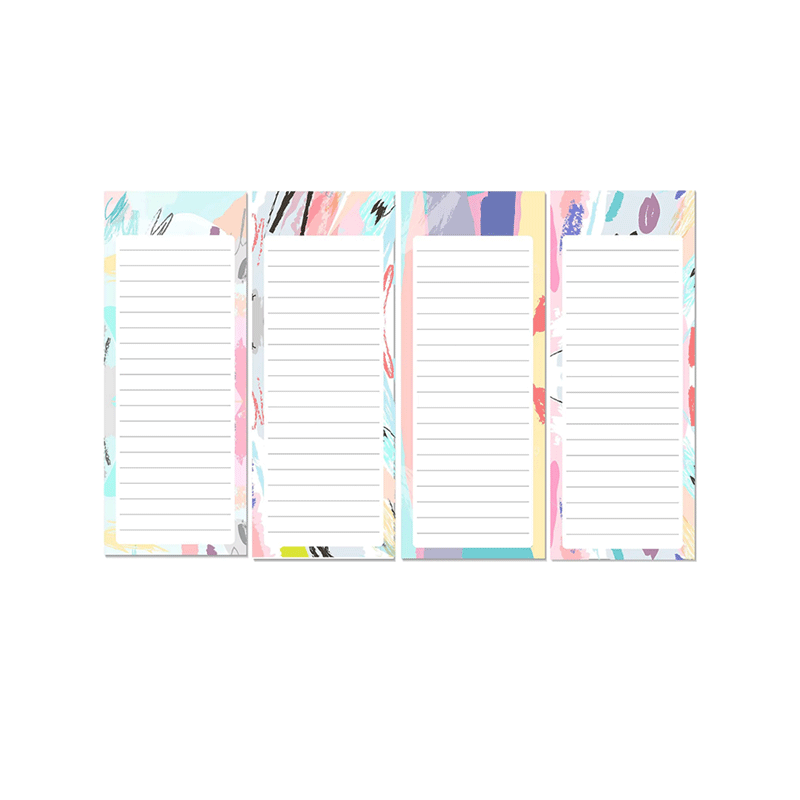
The ruling is what the buyer chooses. Lined for notes. Blank for sketching. Grid for the technical work. A note pad offered in multiple rulings covers the desk, the studio, and the workshop.
The sheet size is the other choice. The small pad, the A6 or the 4 by 6, fits the pocket and the phone table. The large pad, the A4 or the letter, sits on the desk. A note pad in the size the user actually needs gets used. The wrong size gets buried.
The chipboard backing is glued to the bottom sheet. It has to be stiff enough to write on without a desk underneath. A note pad that flexes while writing is a pad that gets set aside.
The corners are square or rounded. The rounded corner resists the dog-ear and looks finished. A note pad with the rounded corner holds its shape longer.
The cut is the trim. The sheets have to be cut square, all the same size. A pad with the uneven edge looks cheap and the sheets do not align. A note pad with the clean trim stacks well and looks professional on the desk.
Here is what a note pad needs to deliver:
The office buys the note pads in the case. The pads sit by every phone and every meeting table. A note pad with the right size and the right ruling keeps the office stocked.
The hotel puts the note pad on the desk and the nightstand. The pad carries the hotel's logo. A note pad with the printed header is the branded item the guest takes home.
The promotional buyer orders the note pads with the company name. The pad is the giveaway that gets used. A note pad with the clean print and the right size is the promo item that stays on the desk.
The sheet will not tear clean because the glue was too strong or the perforation was missing. A note pad with the right glue releases. The sheets curl because the backing was too thin. A proper chipboard holds. The ink bleeds through because the paper was too light. A note pad with the right paper weight writes clean.
A note pad is the stack of paper that gets used every day. The glue holds. The paper takes the pen. The size fits the desk. Choose a pad with the right glue, the right paper, and the right ruling. The notes will get written and the sheets will come off clean.
Copyright © Wenzhou Yinliang Stationery Co., Ltd.
