 English
 Español
 Português
Add: No.6 Longjin Avenue, Jinxia Printing Industry, Jinxiang Town, Cangnan County, Wenzhou City, Zhejiang Province
Tel: +86-19706000801
Wechat: 19706000801

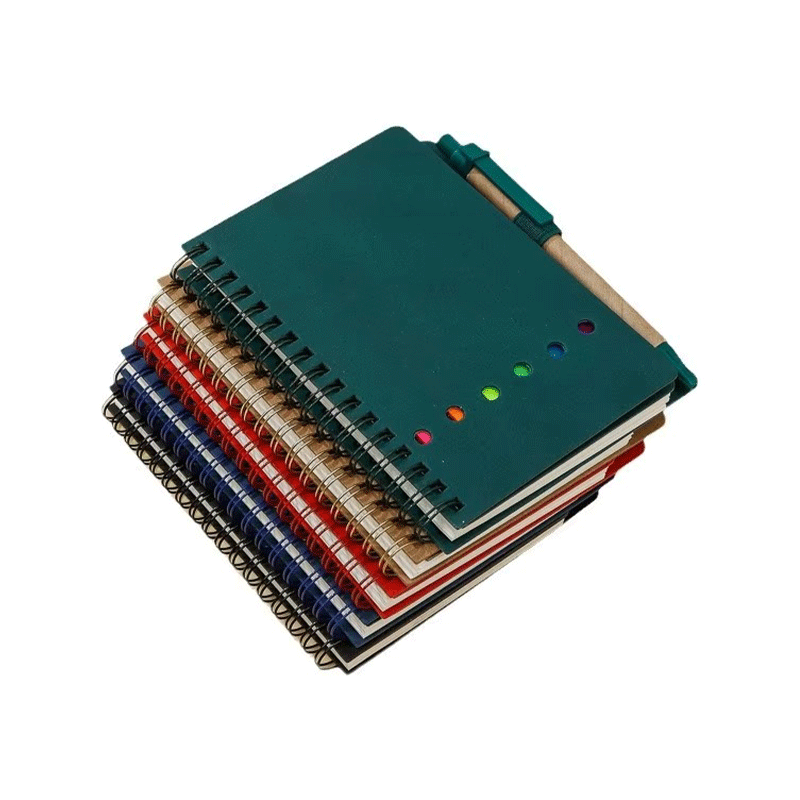
A coil notebook is held together by a continuous spiral of wire or plastic threaded through holes along one edge. The pages turn all the way around and fold back. The notebook lies flat on the desk without a hand holding it open. That single behavior is why the coil notebook has survived every other binding method. The wire is cheap, the tooling is simple, and the result is a notebook that works the way people actually write.
The coil is either metal wire with a coated finish or an extruded plastic tube. Metal is stiffer and holds its shape longer. It does not crack. Plastic is lighter, cheaper, and never rusts, but it can deform under heat or pressure in a bag.
A coil notebook with a metal coil feels more durable in the hand. The pages turn with a slight resistance that tells the user the binding is solid. A plastic coil turns more freely but can bend out of shape when the notebook is crushed.
The coil diameter has to match the page count. Too small and the pages bind against the coil. Too large and the notebook feels loose and the pages shift. A coil notebook with the right diameter turns smoothly from the first page to the last.
The coil passes through a row of holes punched along the edge of every sheet and both covers. The hole spacing and diameter have to match the coil pitch exactly. A mismatch causes the pages to bind or tear.
The holes are punched after the pages are collated. The punch has to be sharp and aligned, or the holes come out ragged and the pages tear at the coil. A coil notebook with properly punched holes turns without catching.
The margin between the holes and the edge of the page is the tear zone. Too little margin and the page tears out under normal use. Too much and the notebook wastes space. A coil notebook with the correct margin holds the pages through the life of the notebook.
The cover protects the pages and carries the print. The front cover is usually a heavier stock, poly, or a printed card. The back cover is heavier still, often a rigid board or a poly sheet, to give the notebook support when it is held in the hand.
A coil notebook with a rigid back cover can be written on without a desk underneath. The cover acts as the writing surface. A notebook with a flimsy back cover flexes and the writing suffers.
The cover print is the brand. The front cover carries the design, the logo, the title. A coil notebook with the printed cover sells on the shelf and identifies the notebook in the bag.
Here is what a coil notebook needs to deliver:
Many coil notebooks have perforated pages. The user tears out a sheet and hands it to someone, and the notebook stays intact. The perforation has to be cut deep enough to tear clean and shallow enough to hold during normal page turning.
A coil notebook with a well-made perforation tears in one motion. A bad one either will not tear or tears into the next page. The perforation line is usually placed a few millimeters inside the holes so the torn sheet comes out with a clean edge.
Students use the coil notebook for lecture notes. The notebook lies flat on the small desk and the pages turn fast. Professionals use it for the meeting notes and the project log. The notebook folds back to fit the clipboard. Field workers use it for the site notes. The rigid back cover gives them a writing surface on the hood of a truck.
The coil catches on the bag, the clothing, the other notebooks. That is the trade-off for the flat-opening binding. A coil notebook with properly crimped ends catches less. A cheap coil with sharp ends snags and bends.
A coil notebook is the notebook that lies flat. The wire holds the pages. The holes let them turn. Choose a notebook with the right coil, the right punch, and the right back cover. The pages will turn and the notebook will stay open.

Copyright © Wenzhou Yinliang Stationery Co., Ltd.
